

An article by Dean van Leeuwen
We keep asking when Artificial Intelligence will become more intelligent than humans, whether AI will replace people, and whether AGI will eventually outperform us. The problem is that the AI conversation is being framed too narrowly. The bigger opportunity is not “Artificial” Intelligence. It is “Advancing” Human Intelligence.
That distinction changes the whole debate. Artificial Intelligence focuses our attention on the machine. Advancing Intelligence focuses our attention on the purpose. The real prize is not simply building smarter machines, but creating smarter leaders, smarter teams, smarter organisations and smarter societies because these new machines now exist. Artificial Intelligence is not the destination. Advancing humanity’s intelligence should be.
A Standoff on the Streets of Nashville
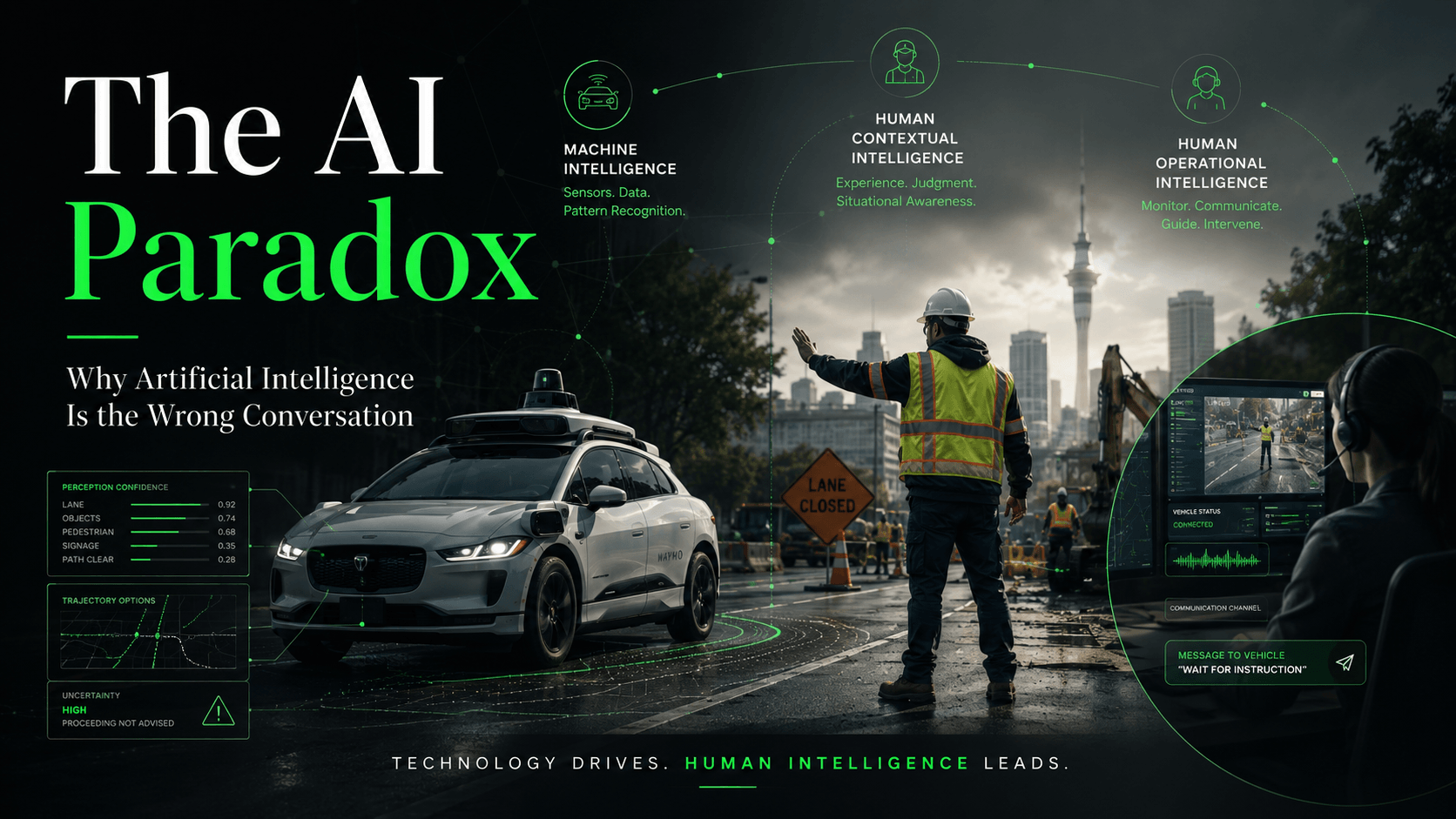
This is why my first Waymo autonomous taxi ride in Nashville stayed with me. The interesting part was not that the vehicle became confused at a set of roadworks. The interesting part was that three different forms of intelligence had to combine to solve the problem: machine intelligence from the Waymo, operational intelligence from the remote specialist, and contextual intelligence from the roadworks foreman.
After talking about self-driving cars for more than a decade, I finally had the opportunity to ride in one. I was in Nashville for a client event when I discovered Waymo had recently launched in the city, and as someone who has spent years talking about future technologies, autonomous vehicles, and the transformation of mobility, there was no way I was leaving without trying it.
I sat in the front passenger seat because I wanted to be close to the action. I wanted to watch the steering wheel turn by itself, observe how the vehicle read the road, and experience what happens when one of the most visible symbols of the future becomes part of an ordinary journey through an ordinary city.
The first fifteen minutes were extraordinary. After years of describing autonomous vehicles in keynotes, workshops, and strategy conversations, I was finally sitting in one, watching the wheel move without a driver as the car navigated Nashville with remarkable confidence.
Then we reached a section of roadworks, and the experience became far more interesting. Fresh asphalt had recently been laid, and without roadwork signs, the temporary traffic flow was not obvious to the vehicle. A roadworks foreman immediately recognised that the Waymo was about to make an expensive mistake and ran into the road to stop it.
That detail stayed with me. He clearly trusted the vehicle to stop. I doubt he would have taken the same risk with a human driver. In that single moment, the autonomous car already had a form of trust, even from someone who was clearly not impressed by what it did next.
The car stopped and then refused to move. The foreman began waving it around the obstruction, using animated hand signals and increasingly colourful language. It had the feel of a modern Western standoff: a roadworks foreman, a robot taxi and a very confused interpretation of progress.
At one point, he turned to me in a Southern drawl and said, “You may as well get out. This car ain’t going anywhere.” He was right. The AI could not interpret the human instruction, could not improvise around the temporary road conditions, and could not make the common-sense judgement that any experienced human driver would have made in seconds.
So I pressed the rider support button. That was when a Waymo specialist came online, assessed the situation, remotely turned the car around and redirected it along a different route.
The Waymo standoff was a great experience – one I will remember for a long time, because it was novel and because it was revealing. The technology was impressive, the real-world context was messy, and the solution came from combining both: machine intelligence and human intelligence, with the human in the lead.
My story is not primarily about the limitations of AI. It’s more about the opportunity we are missing when we focus too narrowly on the “artificial” part of Artificial Intelligence.
The Wrong Questions
Almost every serious AI discussion eventually drifts towards the same question. Will AI become more intelligent than humans? Will artificial general intelligence arrive? Some people say this year. When will machines outthink, outsmart, outperform, and even replace us? These are important questions, but they are the wrong questions, for now at least.
My point is this. So, what if AI becomes more intelligent than humans in certain domains? I have welcomed having a co-worker better than me at things I’m either rubbish at or do not have an aptitude for. AI already plays better chess than humans. Calculators perform arithmetic faster than humans. Search engines can retrieve more information than any human brain could ever store. That does not make them more meaningful or useful than humans, more morally aware, more curious, more empathetic, more courageous or more capable of purposeful judgement.
The more important question is not whether machines become more intelligent than us. The more important question is how much more intelligent humans, teams and organisations can become because of the AI we now have around us.
That is the AI paradox. The more powerful Artificial Intelligence becomes, the more important advancing real human intelligence becomes. Not because humans need to compete with machines on machine terms, but because humans need to lead, interpret, contextualise, question, imagine and decide what these capabilities are for.
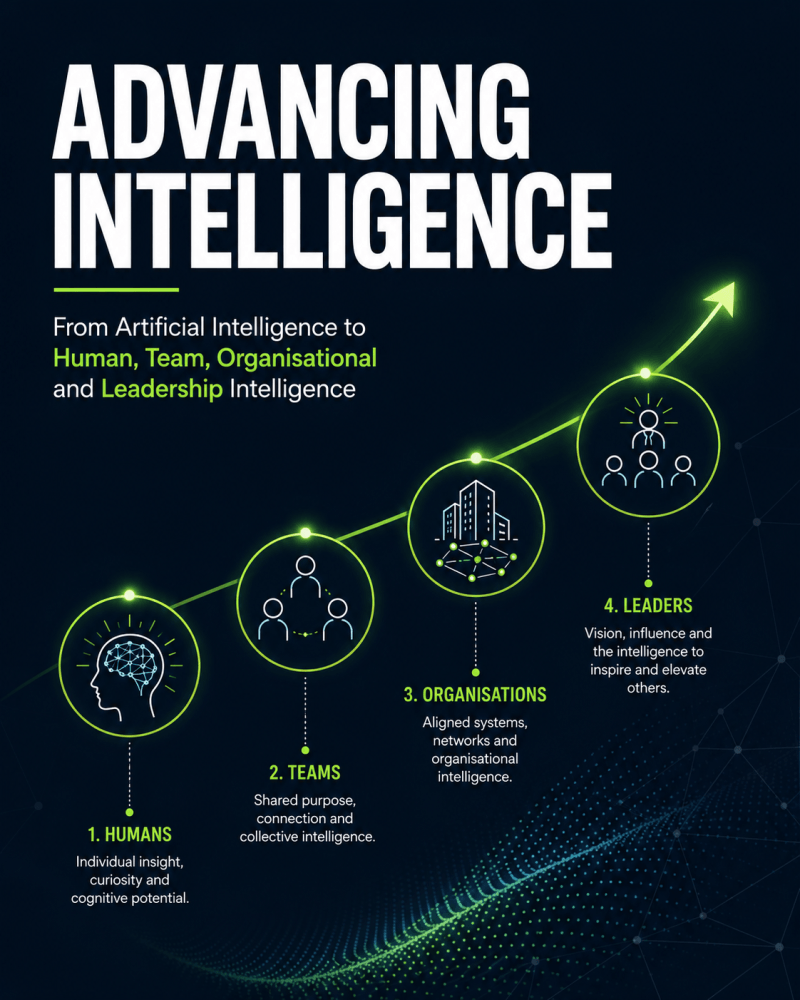
This is why I think the word Artificial may be limiting the strategic conversation. It directs our attention towards the intelligence of the machine, when the bigger opportunity is the advancement of intelligence across the whole human system. Individual intelligence, team intelligence, organisational intelligence, social intelligence and leadership intelligence.
Three Kinds of Intelligence, Working Together
The Waymo incident demonstrated this in a wonderfully simple way. The vehicle brought computational intelligence, using sensors, mapping, software and machine learning to navigate the city. The remote specialist brought operational intelligence, understanding how to intervene in a complex autonomous system. The foreman brought contextual intelligence, instantly recognising the roadworks situation and the common-sense action needed to prevent the vehicle from driving into freshly laid tar.
None of these forms of intelligence was sufficient on its own. The Waymo could navigate the city with extraordinary capability, but it could not interpret the messy human reality of fresh asphalt, improvised traffic flow and a foreman waving instructions in the road. The foreman understood the situation instantly, but he could not communicate with the vehicle in a language the machine could process. The specialist bridged the gap by interpreting the situation and redirecting the system.
The solution came from human and machine intelligence working together. That is the future we should be designing for. Not humans replaced by AI, and not humans merely supervising AI from inside some passive “loop”, but humans in the lead, using AI to extend what individuals, teams and organisations are capable of achieving.
Why “Humans in the Loop” Isn’t Ambitious Enough
This is where I think even the phrase “humans in the loop” is too narrow. It still frames humans as a safety mechanism inserted into a machine process. It suggests that the machine remains the centre of the system and the human is there to monitor, approve or intervene when needed. That is not ambitious or inspiring enough. Humans in the lead is a stronger idea.
The real opportunity is not simply to keep humans in command of AI systems. The real opportunity is to design AI systems that help humanity advance our intelligence. Become more capable, more creative, more insightful and more effective than they could be without them.
In my research on building bionic organisations, I describe this as the fusion of human ingenuity and advanced technology. The organisations that will thrive are not those that simply automate the existing model faster, cheaper and more efficiently. They are the organisations that reimagine what becomes possible when human capability is amplified by machine intelligence.
That distinction matters. Automation asks how we remove humans from work. Augmentation asks how we make humans better at work. Advancing Intelligence asks how we elevate the intelligence of the whole organisation, from the boardroom to the frontline, from leadership decisions to customer experiences, from innovation to execution.
New Work Emerges, Even as Old Work Disappears
The Waymo specialist is a useful example. That role did not exist in that form before autonomous vehicles began reshaping transport. AI did not simply eliminate work from the system. It created new work around orchestration, exception handling, safety, judgement and customer experience.
This is being repeated across every industry. As AI agents, robotics, autonomous systems and intelligent platforms become more capable, new human roles will emerge around sense-making, judgement, trust, empathy, integration, escalation and accountability. Some jobs will disappear, and we should not pretend otherwise. But new forms of work will also emerge, and the leaders who prepare people for advancing intelligence through that transition will create stronger, more adaptive organisations.
I believe there are essential human powers that AI will never truly replicate naturally. Empathy, curiosity, creativity, intuition, passion, collaboration and antifragility are not soft skills sitting at the edge of strategy. They are core forms of human intelligence that become more important as the world becomes more complex, ambiguous and non-linear.
The Waymo was brilliant, but it lacked these powers. It did not become curious about why the road had changed. It did not intuitively interpret the foreman’s gestures. It did not creatively negotiate with the temporary traffic flow. It did not collaborate with the human being standing in the road. It did not reason in the way an experienced human driver would have reasoned in that moment.
Future AI systems will undoubtedly become better at many of these behaviours. They will interpret more signals, anticipate more situations, and handle more edge cases. But that does not mean they will possess real human intelligence in the fullest sense of the word.
Machines may simulate empathy, but they do not care. They may generate creative outputs, but they do not feel the human tension that makes creativity meaningful. They may reason through data, but they do not hold purpose, courage, moral responsibility or lived experience in the way humans do.
This is why I am sceptical of the idea that AGI, when it arrives, resolves the deeper question. Even if AI becomes more powerful than humans across many cognitive tasks, the point remains the same. Intelligence is not only computation. Intelligence is also consciousness, context, meaning, responsibility, and the ability to act in service of something beyond the task itself.
The Real Question for Leaders
The future should not be about making humans smaller because machines can do more. The future should be about using machines to help humans become bigger. More capable, more imaginative, more confident, more connected and more able to solve problems that once felt beyond us.
That is why I think we need to shift the conversation from Artificial Intelligence to Advancing Intelligence. The first phrase focuses on what the machine is becoming. The second focuses on what humans, teams and organisations could become because the machine exists. AI is the tool; advancing humanity’s intelligence is the purpose and the outcome.
For leaders, this changes the agenda. The question is not simply, “How do we deploy AI?” The better question is, “Which forms of intelligence do we want AI to advance?”
Do we want to advance the intelligence of frontline teams by giving them better tools, better data and better decision support? Do we want to advance leadership intelligence by helping executives see patterns, test assumptions and make more adaptive strategic choices? Do we want to advance organisational intelligence by connecting knowledge across silos and turning fragmented data into shared insight?
These are the conversations that matter. They move the AI conversation away from tools, pilots and productivity gains, and towards transformation, capability and human progress.
If leaders approach AI only as an automation technology, they will design for labour reduction. If they approach AI as a capability amplifier, they will design for human advancement. The first path may create short-term efficiency. The second path creates long-term advantage.
The best organisations will not simply ask where AI can reduce cost. They will ask where AI can increase human capability. They will not only build AI strategies. They will build Advancing Intelligence strategies.
This matters because we are living through a once-in-a-century transformation. AI will change jobs, business models, industries and societies. It will create extraordinary opportunities and difficult disruptions. It will produce winners, losers and a great deal of uncertainty in between.
But the outcome is not predetermined. If we remain fixated on the artificial, we may design systems that marginalise people, hollow out capability and treat human beings as inefficient components to be removed. If we focus on advancing intelligence, we have a much better chance of building organisations where technology serves human potential.
A Future Worth Driving Towards
The Waymo eventually drove away from the roadworks, and my journey continued. But I kept thinking about that foreman, the specialist and the strange little standoff between human common sense and machine capability. It was a small moment, but it captured something large.
Artificial Intelligence may be one of the most powerful technologies humans have ever created. But it is still a vehicle. It is not the destination.
The destination is advancing human intelligence. Advancing team intelligence. Advancing organisational intelligence. Advancing the intelligence we need to navigate complexity, make better decisions and achieve things we could not previously imagine.
That is the real AI paradox. The more intelligent machines become, the more important it is that humans lead with intelligence of their own.
And that is a future worth driving towards.
This article was written by Dean van Leeuwen, drawing on his ongoing work helping leaders make sense of what AI means for their people, their strategy and the future they’re building.
It ties in with the latest episode of the Elephants in the Boardroom podcast, where Dean and Graeme dig into where the phrase “humans in the lead” actually came from – a line borrowed from Accenture CEO Julie Sweet and why it changes the AI conversation for leaders. Have a listen here: Episode 18 – Humans in the Lead
Dean van Leeuwen, author of today’s article, helps leaders turn growth plans into delivered results by spotting where value leaks and where teams get stuck in analysis, pilots, and busywork.
He advises executive teams on strategy and change, has worked with L’Oréal, Rio Tinto, GSK, Deloitte, John Lewis, M&S and others, and co-hosts the Elephants in the Boardroom podcast.