


1,300 people. One Oxford study. A 61-point accuracy gap. And a warning for every leader betting on AI.
Earlier this year, researchers at the University of Oxford’s Reasoning with Machines Laboratory ran an experiment that should land on the desk of every executive currently approving an AI pilot.
They built a set of medical scenarios. Some minor. Some life-threatening. Call-an-ambulance-now serious.
When medical professionals used generative AI tools to work through those scenarios, accuracy came in at 95%. Good enough to start trusting these tools in clinical settings.
Then 1,300 ordinary people ran the same scenarios. Same AI tools. Same questions. Same technology.
Accuracy collapsed to 34%.
Not disappointing. Dangerous.
The technology was not the variable. The human was.
The medical experts knew the language of medicine. They knew that “tingling” might be the wrong word. They knew how to push back when the AI’s first answer felt off. They had a built-in filter, calibrated by years of expertise, that told them when something did not add up.
The 1,300 non-experts had none of that. They asked vague questions, accepted confident-sounding answers, and walked away with diagnoses that were wrong roughly two-thirds of the time.
This is the story of enterprise AI in 2026.
Why most AI pilots are quietly failing.
A 2025 MIT study found that almost all enterprise AI projects are failing to deliver real value. The reason is not the technology. The technology works. The reason is that organisations are deploying AI the same way those 1,300 non-experts used it: without the language, the framework, or the workflow design to extract value from it.
Confident-sounding output. Mediocre actual impact. A growing suspicion in the boardroom that something is off.
We see it in client after client. Teams running pilots in every corner of the business. Budgets approved. Vendors smiling. And nobody able to articulate what value has actually been created.
Stop calling it AI. Start calling it IA.
Here is a reframe that changes how leadership teams think about this technology. Stop calling it Artificial Intelligence. Start calling it Intelligent Assistance.
The shift is small. The implications are not.
Artificial Intelligence suggests a replacement. A machine that thinks instead of you. A workforce reduction strategy dressed up as innovation.
Intelligent Assistance suggests something very different. A tool that scales the people you already have. A copilot that extends expertise rather than substituting for it. The Oxford doctors did not get to 95% because the AI was clever. They got there because they were clever, and the AI gave them leverage.
That is the real future of AI in business. Not robot workforces. Bionic teams. Humans focused on judgment, creativity, and relationships, with machines doing the heavy lifting around them.
Where the value actually lives.
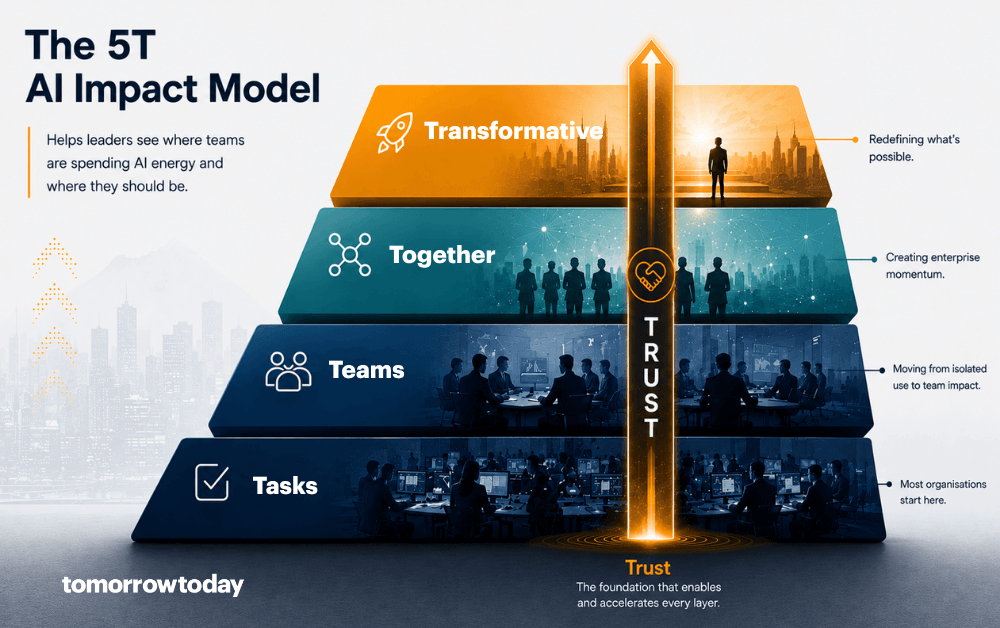
At TomorrowToday, we built the 5T AI Impact Model to give leaders a clear map of where AI energy is being spent, and where it should be spent.
Five levels, in plain English:
Level 1. Tasks. Personal productivity. Automating the small stuff. This is where 95% of organisations are still sitting.
Level 2. Teams. AI as a member of the team, amplifying the expertise that already exists. This is the doctor-with-AI level. This is where Intelligent Assistance begins.
Level 3. Together. Workflow redesign across functions. This is where the real bottom-line profit lives. Almost no one has reached it yet.
Level 4. Transformative. Genuine business model innovation. The level everyone wants. Unreachable without the first three.
Level 5. Trust. Not a step. A pillar running through all four levels. Without trust in the system, nothing above Level 1 holds.
The Oxford study is the 5T model in miniature. AI in the hands of experts (Level 2) became a force multiplier. AI in the hands of non-experts, with no workflow redesign and no governance, became a liability.
What this means for your Monday morning.
If your AI strategy is mostly Level 1 dressed up in Level 4 language, you are not alone. You are the majority. But you are also leaving the actual value on the table.
The leaders who will win the next three years are not the ones with the flashiest pilots. They are the ones who understand a simple truth. AI is never going to replace your people. It is going to augment them. Supercharge them. Make them bionic in what they do.
That is how you get measurable bottom-line impact from AI. Not by replacing expertise. By multiplying it.
The 34% number from Oxford is not a story about medicine. It is a story about what happens when you give powerful tools to people without the framework to use them well.
Want to see where your organisation actually sits on the 5T model?
We are running 90-minute 5T AI Impact Masterclasses for senior leadership teams who want to move beyond the hype and start building real AI value. Fully tailored to your industry, your context, your pressures.
Watch this week’s ThrowForward Thursday, where Graeme walks through the Oxford study in detail.
Graeme Codrington is an internationally recognised futurist and keynote speaker, specialising in the future of work, leadership and disruption. Co-founder and lead futurist at TomorrowToday Global, he helps organisations make sense of what’s next and turn uncertainty into opportunity.
He’s ranked #17 in the Global Gurus Futurist rankings for 2026. Watch his latest showreel here, or chat to us about booking Graeme to help you re-imagine your strategy and spot emerging opportunities in your industry.