

A story by Dean van Leeuwen
In 1714, the British government offered one of the largest prizes in history – £20,000 to anyone who could solve the problem of longitude at sea. Equivalent to millions today.
The greatest scientific minds of the age believed the answer lay in astronomy. The Board of Longitude agreed. Sir Isaac Newton himself was adamant: “It would not be solved by clockwork.”
And then a carpenter’s son from rural England quietly disagreed.
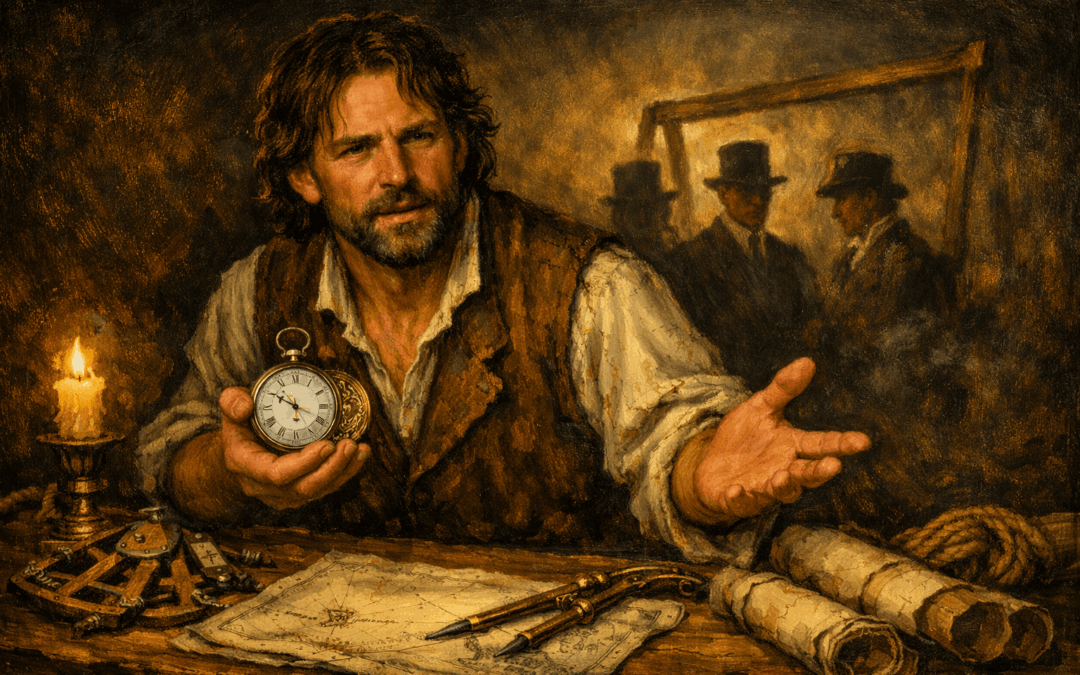
John Harrison wasn’t formally trained as a watchmaker. He wasn’t part of the scientific elite. He wasn’t even supposed to be in the room, but he believed the solution wasn’t in the stars – it was in mechanics.
So he started building.
For decades, he worked on timepieces most experts dismissed as impossible. He faced public criticism, political resistance, shifting criteria, and repeated attempts to undermine his work. Every time he came close, the goalposts seemed to move. Funding dried up. Rivals circled.
He kept building anyway.
Over the course of forty years, Harrison redesigned his solution five times. When his large sea clocks proved impractical, he did something even more radical – he abandoned his own approach.
Instead of building bigger, he went smaller. He shrank the solution to the size of a pocket watch. The final device, what we now know as the marine chronometer, was precise, elegant, and it worked. It allowed sailors to calculate their east-west position at sea with real accuracy for the first time, reducing shipwrecks and opening the world to safer, bolder voyages.
It changed navigation forever. Follow Dean’s thinking on LinkedIn.
But there is another layer to this story.
Harrison didn’t just have to solve the problem. He had to survive the people judging it.
For decades, the Board of Longitude kept adjusting the criteria. New tests. New conditions. New delays. Each time Harrison met the standard, the standard shifted out of reach.
On paper, it looked procedural. Thorough. Responsible.
In reality, it was political.
The establishment had already decided what the solution should look like, and it didn’t look like a clock built by a self-taught outsider from rural England.
So the goalposts moved.
This pattern is uncomfortably familiar.
A new idea is welcomed at first. It’s interesting. It’s bold. It signals progress. But the moment it begins to challenge existing power, reputations, or budgets, the tone changes.
“Have we tested it enough?” “Is it fully proven?” “Perhaps we need another review.”
Resistance rarely announces itself as fear. It disguises itself as a process, and procedural resistance is much harder to confront precisely because it feels reasonable.
Harrison eventually won. Not because the system embraced him, but because he refused to stop building. He outlasted the resistance. Join the conversation on LinkedIn.
What strikes us about this story in 2026 is this: igniting change rarely begins with consensus. It begins with someone willing to question what everyone else is certain about and then absorb the resistance that follows.
Before organisations transform, someone has to challenge the dominant model, and systems rarely surrender their certainty easily.
Most leaders say they want innovation. Fewer are comfortable when it unsettles the structures that gave them authority.
So here are the two questions worth sitting with this week:
If the next Harrison is already inside your organisation, would your system recognise them, or reject them?
And when a sharp new signal shows up, are you genuinely testing it or quietly protecting something?
Because sometimes innovation doesn’t fail. It’s managed out.
If Harrison’s story feels uncomfortably familiar, it might be worth a conversation.
We spend a lot of time helping leaders recognise where resistance is masquerading as process and how to build cultures where the next Harrison actually gets heard.
If you’d like to explore more, contact us – we’d love to connect you with Dean, futurist, strategist, and author of today’s story.
Dean van Leeuwen helps leaders turn growth plans into delivered results by spotting where value leaks and where teams get stuck in analysis, pilots, and busywork.
He advises executive teams on strategy and change, has worked with L’Oréal, Rio Tinto, GSK, Deloitte, John Lewis, M&S and others, and co-hosts the Elephants in the Boardroom podcast.